cepr.team3.admin

New publication in Scientific Reports

📢 Excited to share our latest publication in Scientific Reports! Our study highlights a key but often overlooked factor in cancer immunotherapy: the route of administration. Using preclinical models of lung cancer, we show that delivering immunomodulatory agents directly to the airways can: ✅ Reduce systemic inflammation and toxicity compared with intravenous administration ✅Enhance local anti-tumor immune responses ✅ Increase infiltration of effector T cells in the lungs ✅ Improve tumor control These findings support the development of locally delivered immunotherapies as a promising strategy to improve the efficacy and safety of lung cancer treatments. A big thank you to all co-authors from CEPR INSERM Lab and collaborators who contributed to this work! 🙏 📖 Read the full article here: https://www.nature.com/articles/s41598-026-58254-y #LungCancer #Immunotherapy #DrugDelivery #Immunology #ScientificReports Inserm Grand Ouest Université de Tours CHRU de Tours

MINIRAD project – interregional PHRC 

🎉We are pleased to announce that our MINIRAD project has been selected for funding under the 2025-2026 interregional PHRC (Hospital Clinical Research Program). 🔬 This multicenter project, entitled « Radial endoscopic ultrasound miniprobe as a first-line strategy for the diagnosis of pulmonary nodules and masses with bronchial signs: an open-label, randomized superiority trial, » aims to evaluate an innovative diagnostic strategy in pulmonology. 🎯 The objective is twofold: to improve diagnostic performance while enhancing patient safety, notably through an expected reduction in the risk of pneumothorax during diagnostic procedures. 🙏  Many thanks to all the investigators, partners, and research support teams who contributed to the development of this project. Congratulations to Laurent Plantier for his coordination.

New Article in FEBS Journal

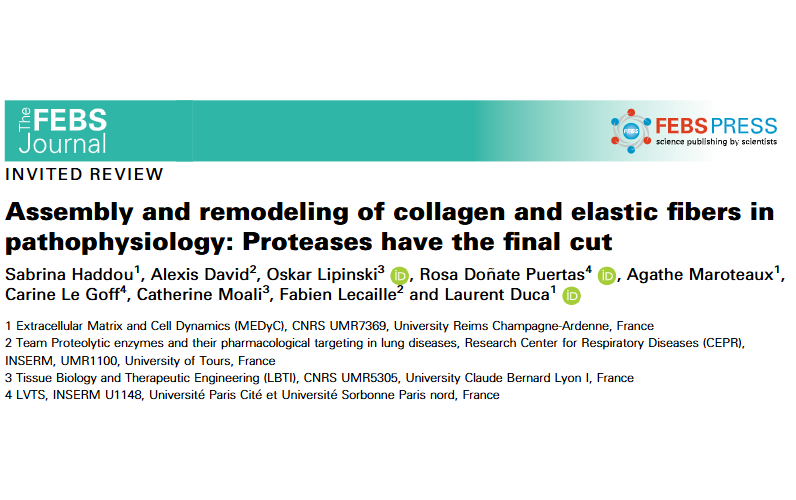
I’m very pleased to share with you the recent publication of our article in FEBS Journal. https://lnkd.in/dAxA5SPf Haddou S, David A, Lipinski O, Puertas RD, Maroteaux A, Le Goff C, Moali C, Lecaille F, Duca L. Assembly and remodeling of collagen and elastic fibers in pathophysiology: Proteases have the final cut. FEBS J. 2026 May 29. Special thanks to all the authors of this review: #SabrinaHaddou, #AlexisDavid, #OskarLipinski , #RosaDoñatePuertas, #AgatheMaroteaux, #CarineLeGoff , #CatherineMoali, #FabienLecaille, and #LaurentDuca Congratulations as well to all the partners/supports involved in this project:• Team Proteolytic enzymes and their pharmacological targeting in lung diseases, Research Center for Respiratory Diseases (#CEPR), INSERM, UMR1100, University of Tours, France• Extracellular Matrix and Cell Dynamics (#MEDyC), CNRS UMR7369, University Reims Champagne-Ardenne, France• Tissue Biology and Therapeutic Engineering (#LBTI), CNRS UMR5305, University Claude Bernard Lyon I, France• #LVTS, INSERM U1148, Université Paris Cité et Université Sorbonne Paris nord, France• #SFBMEC (Société Française de la Biologie de la Matrice Extracellulaire)• #CancéropoleGrandOuest (#RéseauMoléculesmarinesmétabolismecancer)-

Decision-making for ICU admission: is there a place for AI?

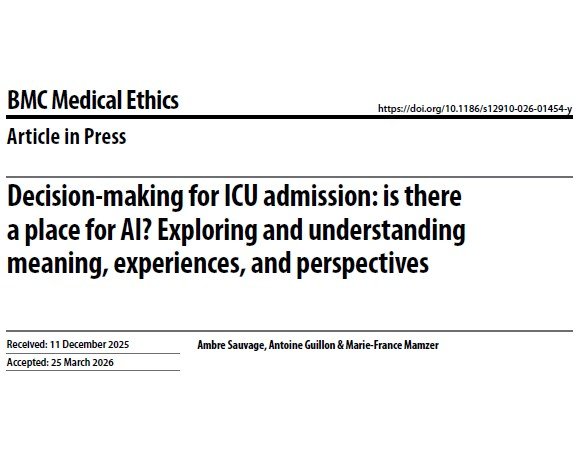
😊 We are pleased to share a recent article co-authored by Antoine Guillon, published in BMC Medical Ethics. 🔍 This study explores a key question in critical care: can artificial intelligence support ICU admission decisions?Through qualitative interviews with intensivists, the authors highlight the complexity, subjectivity, and ethical dimensions of these decisions, while shedding light on both the potential and the limits of AI in this context ! 💡 A thought-provoking contribution at the intersection of medicine, ethics, and innovation. 👉 Read the article: https://link.springer.com/article/10.1186/s12910-026-01454-y

❓How can we better quantify the host response during sepsis?

😊 Very proud to share our new article published in the prestigious The Lancet Respiratory Medicine journal! 🎓 In this work, we developed a parsimonious machine-learning tool to define and quantify immune dysregulation, supporting a more biologically informed approach to immunomodulation.This approach has the potential to improve prognostication, enhance the evaluation of treatment responses, and identify patients most likely to benefit from targeted immunomodulatory therapies. CEPR INSERM LabUniversité de ToursInserm Grand Ouesthashtag#immunomodulation hashtag#machine-learning hashtag#clinical data https://www.sciencedirect.com/science/article/pii/S2213260025004291  

journée scientifique du CEPR

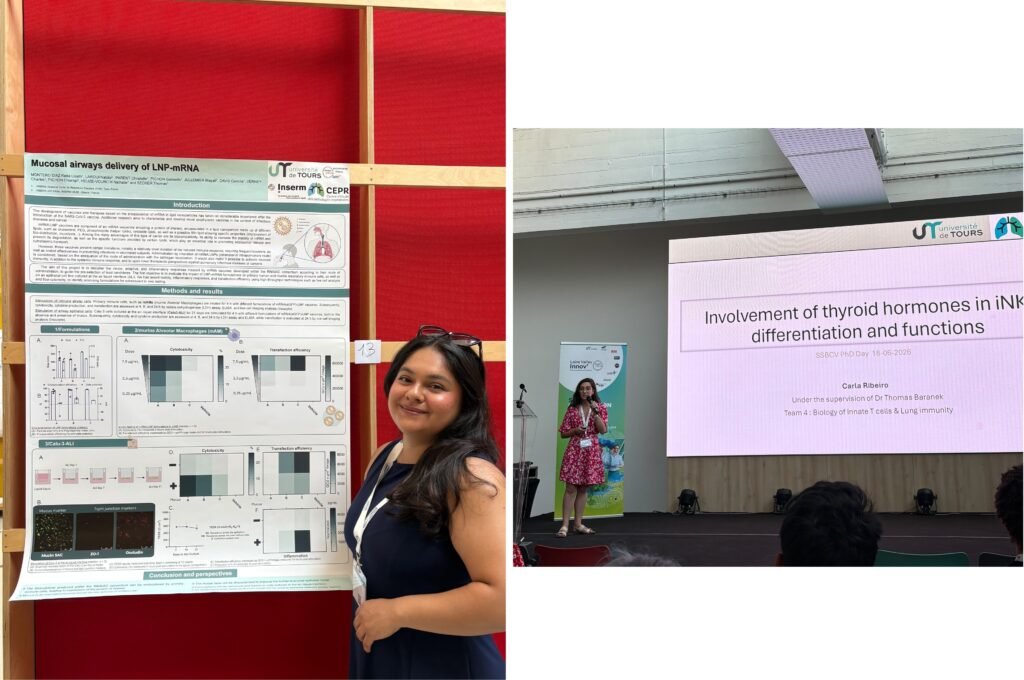
Cette journée scientifique du CEPR a été un véritable temps fort, de réflexions et de contributions inspirantes autour des thématiques qui animent notre laboratoire. Ces moments partagés ensemble, dans un cadre agréable, ont largement favorisé la convivialité, stimulé l’inspiration et créé une très belle énergie collective ! Un grand merci à tous et à toutes pour votre implication et votre ouverture, ainsi qu’aux intervenants et aux organisateurs pour la qualité de cette journée. Cette retraite illustre parfaitement que, malgré les aléas de la vie d’un laboratoire de recherche, il est toujours possible de créer des espaces de collaboration et de faire émerger des idées fortes et porteuses de sens.