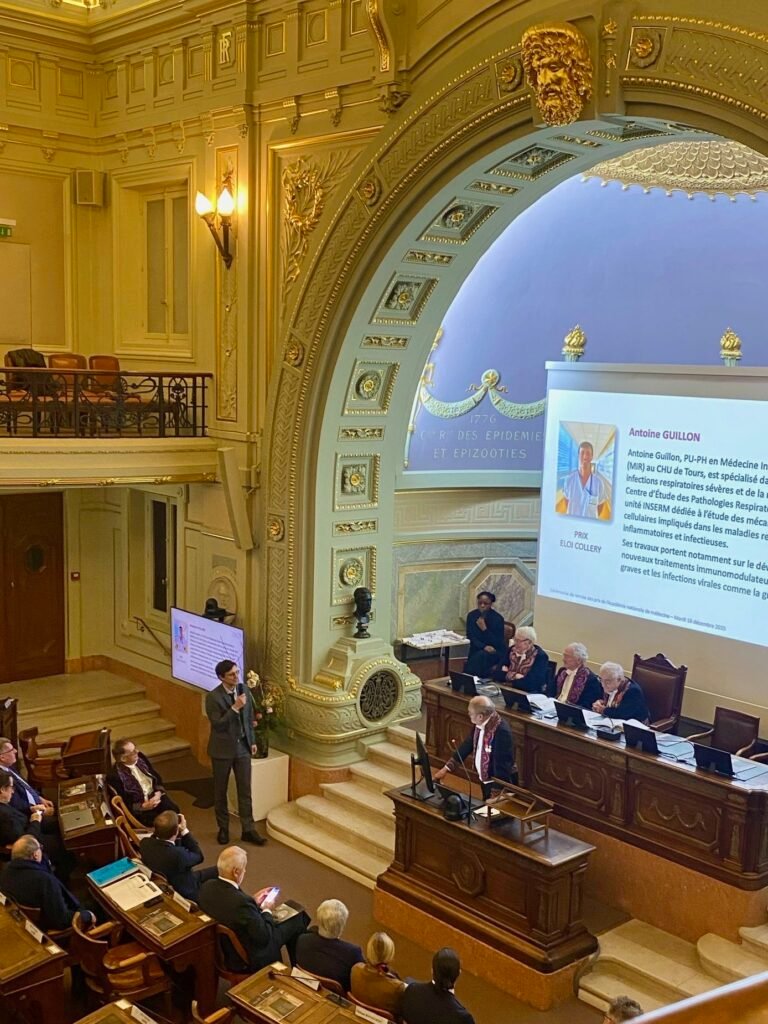
Professor Antoine Guillon Awarded the Eloi Collery Prize for His Research on Influenza » On December 16, the French National Academy of Medicine awarded the Eloi Collery Prize to Professor Antoine Guillon, in recognition of his research achievements over the past five years. His work has notably led to the discovery of the antiviral effects of specific metabolites from the Krebs cycle, paving the way for novel therapeutic strategies against influenza. A clear objective: improving therapeutic responses to influenza Influenza viruses are among the most contagious pathogens, infecting more than one billion people worldwide each year. In France, seasonal influenza causes three times more deaths than road traffic accidents. Current vaccines and antiviral treatments, including oseltamivir, remain of limited efficacy, underscoring the urgent need for innovation based on a deeper understanding of host–pathogen interactions. As an intensive care physician in a 37-bed unit at Tours University Hospital (CHRU de Tours), Professor Guillon is confronted each winter with the lack of effective, targeted therapies for severe influenza. He is also a researcher at the Center for the Study of Respiratory Diseases (CEPR, Inserm UMR 1100), where he works closely with Dr. Mustapha Si-Tahar, Director of the CEPR. Together, they investigated the respiratory metabolome of influenza-infected patients and identified a marked dysregulation of succinate, a key metabolite of the Krebs cycle. They subsequently demonstrated that succinate, traditionally known for its role in energy production, also has a previously unrecognized immune function. At therapeutic doses, succinate disrupts the viral life cycle by inducing a modification of a viral protein—the nucleoprotein—thereby preventing viral assembly. In preclinical models, influenza-infected mice treated with succinate survived, in contrast to untreated controls. These findings, published in EMBO in 2022, opened new perspectives in influenza immunometabolism. Immunometabolism and influenza: a new frontier in drug discovery Further exploration of Krebs cycle metabolites led to the identification of an even more promising compound: cis-aconitate. This metabolite not only blocks viral replication through inhibition of the viral polymerase but also exerts potent anti-inflammatory effects. This dual mechanism is critical, as mortality in severe influenza is largely driven by immune dysregulation, sometimes referred to as an “inflammatory storm.” Treatment with cis-aconitate therefore enables effective management of severe respiratory infections, even in situations where the current standard of care, oseltamivir, loses efficacy. These discoveries resulted in an international patent (Guillon & Si-Tahar, WO 2024/126742), positioning cis-aconitate as an innovative therapeutic candidate for influenza. This work has been supported by multiple funding bodies, including ANR, C-VALO, and France 2030. By exploring the interactions between mitochondria and viruses, two ancient biological entities, this research opens a highly promising avenue for future therapeutic development.